
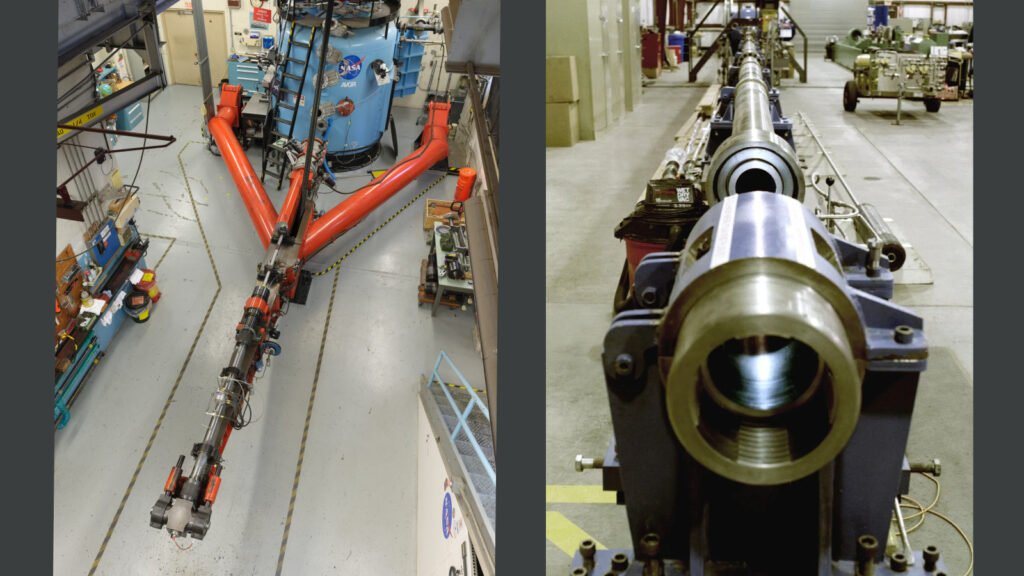
Longshot Space Technologies is building a compressed-gas cannon at Alameda Point in California, and it has hardware behind the headlines. The company’s published timeline records a 6-inch bore, 60-foot accelerator that reached Mach 4.2 over more than 100 shots, and its June 2026 funding announcement describes its current prototype as the largest ballistic launching device operating anywhere today. The long-term goal is to shoot satellites into low Earth orbit instead of launching them on rockets.
The company started in a San Jose garage in 2020 with a multi-injection accelerator, which is a tube that pushes a projectile with a sequence of compressed-gas injections spaced along the barrel rather than one charge at the breech. Air Force SBIR money followed, then an AFRL TACFI contract in 2024. In September 2025 Longshot signed a lease with the City of Alameda for a former US Navy indoor cannon test building, where it is assembling a 30-inch inner diameter, 120-foot accelerator. In June 2026 it announced $5 million from South Park Commons, bringing total funding to $20 million, and said the new capital would fund a test gun at an undisclosed site designed to push 100-kilogram payloads past Mach 5.
What has to happen after the projectile leaves the barrel
Mach 23 is the number in most of the coverage. Longshot’s own FAQ says something more specific: the minimum viable launcher targets a muzzle velocity of about Mach 14, roughly 4.8 kilometres per second at sea level, and the payload only reaches 8 kilometres per second after onboard boosters fire.
That gap is the whole engineering problem, and it is not a detail.
A gun delivers all of its energy in one place, at the muzzle. Everything afterwards is ballistics. A projectile fired from the ground follows an arc whose lowest point sits at or below the height it was fired from, so it comes back down. Orbit requires raising that low point clear of the atmosphere, and the only way to do that is to burn something near the top of the arc. A gun bolted to the desert floor cannot be there.
So the projectile carries a rocket. A circular orbit at 200 kilometres altitude needs about 7.8 kilometres per second. The barrel supplies roughly 4.8, and the atmosphere immediately takes some of that back. How much depends on the projectile’s mass relative to its frontal area and on the launch angle, but for a dense body of this size it runs from several hundred metres per second to well over a kilometre per second. That leaves the onboard motor to find something in the region of 3.5 kilometres per second. Run the rocket equation at a specific impulse of 300 seconds and roughly 70 percent of the projectile’s launch mass has to be propellant. The satellite is a minority passenger inside what amounts to an upper stage that begins its flight being shot out of a tube.
Then there is the air. Orbital rockets are deliberately slow where the atmosphere is thick, which keeps peak dynamic pressure to a few tens of kilopascals. A projectile leaving a barrel at sea level at 4.8 kilometres per second sees about 14 megapascals, near 140 atmospheres, hundreds of times what a launch vehicle is designed around, and it sees it at the moment it is both fastest and lowest. Longshot’s stated answer is heat shielding of the kind used on 1970s ICBM reentry vehicles, which the FAQ says the company intends to demonstrate over the next few years.
Then there is acceleration, and here the arithmetic is friendly. Average acceleration in a barrel is muzzle velocity squared divided by twice the barrel length, so length is the design variable. Reaching Mach 14 in a 5-kilometre barrel averages about 230 g, which is where the FAQ’s figure of roughly 250 g comes from. The same exit speed spread over the 10-kilometre barrel mentioned elsewhere on the site would be closer to 115 g. Longshot’s home page lists a 5-kilometre gun as the next step up.
Compare that with the laboratory guns Longshot cites as precedent. NASA’s White Sands Test Facility describes its 1-caliber two-stage light gas gun accelerating projectiles to 23,000 feet per second, about 7 kilometres per second, in 24 feet of barrel. That averages somewhere near 340,000 g. NASA’s hypervelocity impact pages also note that the target tank has the air removed to imitate vacuum. Orbital speeds in a gun barrel have been routine since the 1950s at gram scale, in an evacuated tube, firing at a wall. Doing it with 100 kilograms, through sea-level air, at a few hundred g, is the part nobody has done.
The business that pays for the gun
Longshot’s near-term revenue is not launch. It is ground testing for hypersonic weapons programmes, which today depend on scarce and heavily booked government facilities of the kind NASA runs at its Ames ballistic range complex. The company holds an AFRL TACFI contract, a Missile Defense Agency Phase II, a position on the Golden Dome IDIQ, and a place on the Mettle Ops team awarded the SHIELD IDIQ in December 2025. It joined the Air Force’s Velocity Alliance test-infrastructure consortium in July 2026 and was assessed awardable for the DARPA ERIS marketplace in August 2026.
The test gun described in the June announcement targets Mach 5 with a 100-kilogram payload. Mach 5 is the threshold where hypersonic flight begins, and it is roughly a third of the muzzle speed the orbital concept needs. That ratio is the honest measure of where the programme sits.
The financing gap is the other one. Twenty million dollars has bought a 60-foot gun, a 120-foot gun, and a building. A 5-kilometre accelerator is infrastructure of a different order, and a 10-kilometre one more so. Longshot’s own FAQ sets the expectation plainly, saying the team would be “pretty sad” if it took until 2035 to put something in space.
What is demonstrated so far is Mach 4.2 through a 6-inch bore and a 30-inch machine under assembly. What is not demonstrated is a heat shield surviving a hypersonic exit at sea level, a guided rocket stage that still works after a few hundred g, or a barrel long enough for either to matter. None of that is physics anyone disputes. All of it is money and hardware.
Contract and funding figures in this piece are current to September 2026.